ADR Road Transport
The ADR agreement, documentation, exemptions and marking.
1. ADR
ADR (French: Accord relatif au transport international des marchandises dangereuses par route) — the Agreement concerning the International Carriage of Dangerous Goods by Road.
In most Contracting Parties, ADR requirements also apply to domestic carriage through national law. Annex A sets rules for the goods, their classification, packaging, marking and documentation. Annex B covers requirements for vehicles, crews and carriage. ADR is amended on a two-year cycle.
ADR covers:
- classification of dangerous goods and assignment of a UN number;
- requirements for packaging, tanks and their approvals;
- hazard labels and marks on packages;
- marking of the transport unit and, where applicable, of a tank or container;
- transport documentation and information for participants in the carriage;
- procedures for an accident, spill or another incident;
- vehicle equipment;
- training for persons whose work concerns the carriage and driver qualifications.
Nine hazard classes
ADR divides dangerous goods into nine classes. A class identifies the type of hazard. Packing group I, II or III is separate information and — where assigned — indicates the degree of danger: I high, II medium and III low.
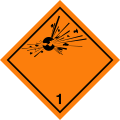 1explosives
 2gases
 3flammable liquids
 4flammable solids
 5oxidisers and peroxides
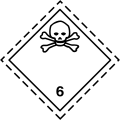 6toxic and infectious
 7radioactive
 8corrosive
 9miscellaneous dangerous
Example transport labels: Wikimedia Commons, “ADR labels of danger”.
| Class | Scope |
|---|---|
| 1 | Explosive substances and articles. |
| 2 | Gases: flammable, non-flammable and non-toxic, and toxic. |
| 3 | Flammable liquids. |
| 4 | Flammable solids, substances liable to spontaneous combustion and substances which, in contact with water, emit flammable gases. |
| 5 | Oxidising substances and organic peroxides. |
| 6 | Toxic and infectious substances. |
| 7 | Radioactive material. |
| 8 | Corrosive substances. |
| 9 | Miscellaneous dangerous substances and articles, including some lithium batteries. |
2. Road transport: driver, vehicle and procedures
Driver and ADR training
Where the carriage requires an ADR training certificate, the driver must hold a valid certificate appropriate to the method of carriage and the class of goods. The system includes four basic training scopes:
- basic training — the foundation for carriage in packages;
- specialised tank training — required for certain carriage in tanks;
- specialised training for Class 1 — explosives, for example certain fireworks, ammunition or other articles classified in Class 1;
- specialised training for Class 7 — radioactive material.
Basic training does not authorise carriage of Class 1 or Class 7. A tank specialisation is determined by the type of carriage and the capacity of the tanks, not by the product name alone. In some cases the carriage also requires a vehicle of a specified type, such as FL for the relevant tank carriage.
Under exemption 1.1.3.6, the driver generally does not need an ADR training certificate. Chapter 1.3 training nevertheless remains applicable to persons whose activities concern consigning, packing, loading, carriage, unloading or documentation of dangerous goods.
Vehicle and marking
Package marking must be distinguished from vehicle marking. A class label, for example “3”, is placed on a package. Orange plates concern the transport unit. Large hazard placards are used, among other cases, on tanks, vehicles carrying goods in bulk and certain containers.
- For carriage in packages that meets the conditions of exemption 1.1.3.6, orange plates are not required. Where exemption 1.1.3.6 cannot be applied, the transport unit is, as a rule, marked with orange plates at its front and rear. Other specific ADR exemptions must be assessed separately.
- A plate with the hazard identification number and UN number, for example 33 / 1263, is not a marking for every pallet of paint. Its use depends on the method of carriage, especially carriage in tanks or in bulk.
- An ADR certificate of approval applies only to certain vehicle types, including EX/II, EX/III, FL, AT and MEMU. Not every vehicle carrying ADR goods in packages needs that certificate.
- Equipment includes, among other things, fire extinguishers, a wheel chock, two self-standing warning signs and personal equipment for the crew. The exact set depends on the mass of the transport unit, the class and the method of carriage.
Tunnels
Tunnel restrictions are identified with codes A–E. Code E is the most restrictive category. The code in Table A must be read together with the method of carriage.
Insurance
For insurance cover to apply, the carrier’s policy should expressly cover the relevant category or class of ADR goods. The scope of carrier’s liability, CMR cover, public liability and any environmental insurance should be checked in the policy terms and in the contract of carriage. In particular, verify exclusions for dangerous goods, spill damage, environmental damage and carriage in tanks.
Accident, spill, fire, stop or another event
General safety rules can be stated, but procedures always depend on the specific goods, their class, packaging and the type of hazard. Instructions for a flammable liquid, a toxic substance, radioactive material or goods carried in a tank can differ substantially. During a stop, consider ADR requirements for supervision and the stopping place, as well as the carrier’s rules, site manager’s rules and local law.
- Stop the vehicle and secure the area, provided this can be done without putting people at risk.
- Switch off the engine and avoid ignition sources; do not touch spilled material.
- Keep bystanders away and alert emergency services, giving the UN number, proper shipping name, hazard class, location and nature of the event.
- Use written instructions and equipment only where doing so is safe for the crew.
- Do not enter the danger zone or attempt firefighting or containment when doing so may cause injury.
- During a stop, do not leave the vehicle where the required control over the load cannot be maintained; some ADR goods are subject to additional supervision and parking rules.
3. Documentation
ADR uses the term transport document. A CMR consignment note can fulfil that function only where it contains all ADR particulars required for the actual carriage.
DGN (Dangerous Goods Note) is a document for dangerous goods, used primarily in combined transport. It may be required where the planned route includes a ferry crossing or where road transport forms part of a larger intermodal chain. The requirement, format and method of transmitting the document depend on the sea carrier, terminal and rules applicable to the next mode of transport.
ADR entry in the transport document
For each substance or article, the entry must be given in the sequence specified by ADR. The general format is:
UN 1263 example
4. Exemption 1.1.3.6 — “1,000 points”
The correct reference is 1.1.3.6. It is a partial exemption for specified quantities of dangerous goods carried in one transport unit. The usual expression “1,000 points” does not mean 1,000 kg or 1,000 litres.
The limit depends on the transport category given in Table A. For mixed loads, the sum of all ADR goods in the transport unit is calculated:
For UN 1263 in the example, the transport category is 2. With no other ADR goods in the vehicle, the maximum quantity of this goods is therefore 333 L. Example: 120 L × 3 = 360 points.
What remains mandatory
- correct classification, packaging, labels and package marks;
- securing the load and following loading rules;
- ADR Chapter 1.3 training for persons whose work concerns the carriage;
- a transport document with particulars relevant to the exemption;
- at least one portable fire extinguisher with a minimum capacity of 2 kg or equivalent extinguishing capacity for the transport unit.
Where the conditions of 1.1.3.6 are met, the driver usually does not need an ADR certificate and orange plates are not required. This is not carriage without ADR requirements.
All ADR goods in the transport unit count towards the limit. Do not calculate separate pallets, orders or consignments from different senders separately.
5. LQ — Limited Quantities
LQ is a separate regime from exemption 1.1.3.6. It is not based on “1,000 points”; it depends on the goods, the limit for the inner packaging and correct preparation of the package.
The LQ limit is given in ADR Table A. For UN 1263 in this example it is 5 L in one inner packaging. It is not a limit for an entire pallet or vehicle.
- the goods must be permitted for LQ under the relevant entry;
- the inner packaging must not exceed the Table A limit;
- the outer packaging must meet LQ conditions; as a rule, maximum gross mass per package is 30 kg, or 20 kg for trays wrapped in shrink or stretch film;
- the package must display the appropriate LQ mark.
6. Example entry — UN 1263
The entry below shows how to read data from ADR Table A. Classification of a specific product must always be confirmed by the current safety data sheet, especially section 14.
| Table A field | Value | Meaning |
|---|---|---|
| UN No. | 1263 | UN number identifying the goods in transport. |
| Name and description | PAINT / PAINT RELATED MATERIAL | PAINT or PAINT RELATED MATERIAL; including paints, lacquers, enamels, stains, shellac, thinners and liquid lacquer bases — for the stated variant with vapour pressure at 50°C above 110 kPa. |
| Class | 3 | Flammable liquids. |
| Classification code | F1 | Classification code for a flammable liquid. |
| Packing group | II | Packing group II — medium danger. |
| Labels | 3 | Class 3 hazard label on the package. |
| Special provisions | 163, 367, 640C, 650 | Special provisions. Read their text in the current ADR. |
| Limited quantities | 5 L | LQ limit for one inner packaging. |
| Excepted quantities | E2 | A separate exemption for excepted quantities. It is not LQ or 1.1.3.6. |
| Packing instructions | P001 | Basic packing instruction for packages. |
| Mixed packing | MP19 | Conditions for packing together with other materials. |
| Portable tanks / ADR tank code | T4 / L1,5BN | Data for portable tanks and ADR tanks; it does not automatically apply to cans, jerricans or drums. |
| Vehicle for tank carriage | FL | Vehicle type for the relevant tank carriage. |
| Transport category / tunnel code | 2 (D/E) | Category for 1.1.3.6 calculations and the tunnel restriction code. |
| Operation | S2, S20 | Provisions for the conditions of carriage in the relevant case. |
| Hazard identification No. | 33 / 1263 | 33 — highly flammable liquid; 1263 — UN number of the goods. This pair is not used on every vehicle carrying UN 1263 packages. |
Equipment related to UN 1263 carriage
For carriage to which the general ADR requirements apply, equipment is determined by ADR 8.1.4 and 8.1.5 and the written instructions. For Class 3, check in particular:
Basis and verification: current ADR, in particular Table A and chapters 1.1.3.6, 1.3, 3.4, 5.3, 5.4, 8.1 and 8.2; the product safety data sheet; and requirements of the carrier, ferry, terminal and transit country. Historical data and number of Contracting Parties: United Nations Treaty Collection. Pictograms: Wikimedia Commons.